

Stretch Film Guide: Types, Uses, Specifications and Buying Tips
Stretch film is one of the most widely used materials for securing palletized goods during storage and transportation. Although it appears simple, selecting the wrong film can result in unstable pallets, damaged products, excessive packaging consumption and higher labor costs.
This stretch film guide explains how stretch film works, the main types available, how to compare specifications and how to choose an appropriate film for different packaging applications.
As a professional packaging film supplier, Foshan JYE Packaging Materials Co., Ltd provides stretch film wrap, such as hand stretch film, machine stretch film, jumbo rolls and customized stretch film for customers in industries or export markets. Our team helps buyers match film specifications to their load weight, wrapping equipment and transportation conditions instead of selecting products based only on roll price.
What Is Stretch Film?
Stretch film, also known as stretch wrap or pallet wrapping film, is a highly stretchable plastic film used to wrap and secure products.
Most industrial stretch film is manufactured from linear low-density polyethylene, commonly abbreviated as LLDPE. The film stretches around a load and uses elastic recovery to maintain holding force. Its cling properties allow overlapping layers to attach to one another without adhesives, tape or heat sealing.
Stretch film is commonly used to:
Stabilize cartons and products on pallets
Protect goods from dust, moisture and surface contamination
Reduce product movement during transportation
Combine multiple packages into one handling unit
Conceal valuable or sensitive products
Improve warehouse organization and load identification
Stretch film should not be confused with shrink film. Stretch film is applied by tension and wraps tightly around a product. Shrink film is loosely applied and then exposed to heat so that it contracts around the item.
Main Types of Stretch Film
The correct stretch film depends on the application method, pallet configuration, required holding force and packaging volume.
Hand Stretch Film
Hand stretch film is designed for manual pallet wrapping. An operator holds the roll directly or uses a handheld dispenser while walking around the pallet.
It is suitable for:
Warehouses with low or moderate packaging volumes
Irregularly shaped pallets
Small production facilities
Temporary or mobile packaging operations
Loads that cannot easily be placed on a wrapping machine
The main advantages of hand stretch film are flexibility, low equipment requirements and ease of use. However, wrapping consistency can vary between operators. Film tension, overlap and the number of layers should therefore be standardized.
Foshan JYE Packaging Materials Co., Ltd can supply hand stretch film in widths, thicknesses, roll weights or core sizes, with packaging configurations adapted to distributors, warehouses and industrial users.
Machine Stretch Film
Machine stretch film is used with semi-automatic or fully automatic pallet wrapping equipment. It is engineered to operate under controlled tension and higher stretch levels.
Machine stretch film is generally preferred for:
High-volume production lines
Distribution centers
Beverage, food and consumer goods factories
Logistics operations requiring consistent pallet stability
Companies seeking to reduce manual packaging labor
A properly matched machine film can improve wrapping consistency and reduce film consumption per pallet. However, the film must be compatible with the machine’s pre-stretch system, operating speed and tension settings.
When evaluating a machine stretch film, buyers should provide the machine model, pre-stretch ratio, current film specification, pallet dimensions and approximate load weight.
Pre-Stretched Film
Pre-stretched film is mechanically stretched during manufacturing before being wound onto the roll. It requires less force during application and can help operators achieve more consistent wrapping.
It is often used for
Lightweight or medium-weight pallets
Manual wrapping operations
Loads that may be damaged by excessive wrapping tension
Businesses seeking easier film application
Because pre-stretched film is already elongated, it behaves differently from conventional stretch film. Its suitability should be tested on the actual pallet rather than judged only by thickness.
Mini Stretch Film
Mini stretch film is a narrow-width film designed for bundling small products, profiles, pipes, cartons, cables and industrial components.
It can replace twine or tape in some applications and is useful for:
Combining small packages
Securing long or narrow products
Protecting product surfaces
Holding components together during internal transport
Wrapping only part of a product
Colored and Opaque Stretch Film
Colored stretch film can support warehouse identification, inventory classification and shipment coding. Black or opaque film can also conceal products and reduce visibility during storage and transport.
Common applications include:
Separating products by destination
Identifying different production batches
Distinguishing rejected or quarantined goods
Concealing high-value products
Supporting warehouse color-coding systems
Color consistency and opacity should be confirmed through samples, especially when the film forms part of a customer’s operational identification system.
UV-Resistant Stretch Film
Standard stretch film may deteriorate when exposed to sunlight for extended periods. UV-resistant stretch film contains additives intended to improve outdoor storage performance.
Buyers should specify:
Expected outdoor storage period
Geographic location
Seasonal temperature range
Intensity of sunlight exposure
Required film color
Whether the pallet will be covered
UV resistance is not unlimited. The supplier should recommend a formulation based on the actual exposure conditions.
Vented Stretch Film
Vented or perforated stretch film contains openings that allow air, moisture or heat to escape.
It may be suitable for:
Fresh produce
Flowers and plants
Chilled or frozen goods
Products packed while warm
Loads requiring airflow
Goods vulnerable to condensation
The hole pattern, ventilation rate, film strength and load stability must be balanced carefully. Excessive perforation can reduce containment performance.
Cast Stretch Film vs. Blown Stretch Film
Stretch film can be produced using cast extrusion or blown extrusion. Each process creates different film characteristics.
| Feature | Cast Stretch Film | Blown Stretch Film |
| Clarity | Generally high | Usually more cloudy |
| Noise during application | Quieter | Louder |
| Unwind characteristics | Smooth and controlled | Stronger resistance |
| Puncture resistance | Good for regular loads | Often preferred for sharp or irregular loads |
| Thickness consistency | Highly uniform | May have greater variation |
| Typical application | General warehouse and automated wrapping | Heavy, irregular or demanding loads |
Cast stretch film is widely used for standard pallet wrapping because of its clarity, quiet unwind and consistent performance. Blown stretch film may be selected when loads have sharp corners, irregular shapes or demanding transport conditions.
Neither process is automatically better for every application. The correct choice depends on the load profile and wrapping system.
Understanding Stretch Film Thickness
Stretch film thickness may be expressed in microns, millimeters, mil or gauge, depending on the market.
A thicker film is not always more economical or more effective. Film performance also depends on resin formulation, extrusion quality, layer structure, stretch capacity, puncture resistance and load retention.
A high-performance thinner film may outperform a poorly manufactured thicker film in a specific application. Buyers should therefore compare cost per wrapped pallet, not only cost per kilogram or cost per roll.
At Foshan JYE Packaging Materials Co., Ltd , film recommendations are based on testing or quality-control process, such as thickness measurement, tensile testing, elongation testing, dart impact testing or pallet trials. This approach helps customers avoid unnecessary material use while maintaining load security.
Key Stretch Film Performance Properties
Stretchability
Stretchability indicates how much the film can elongate before breaking or losing useful performance. Higher stretch capacity can potentially reduce film usage, but only when the film is applied correctly.
Machine film specifications should be matched to the wrapper’s pre-stretch capability. Using a film outside the machine’s suitable operating range can cause breakage, poor containment or unstable wrapping.
Holding Force
Holding force is the tension that remains after the film has been stretched around a load. It helps keep cartons and products together during handling and transport.
Too little holding force may allow the pallet to shift. Excessive force may crush lightweight cartons, deform products or damage pallet corners.
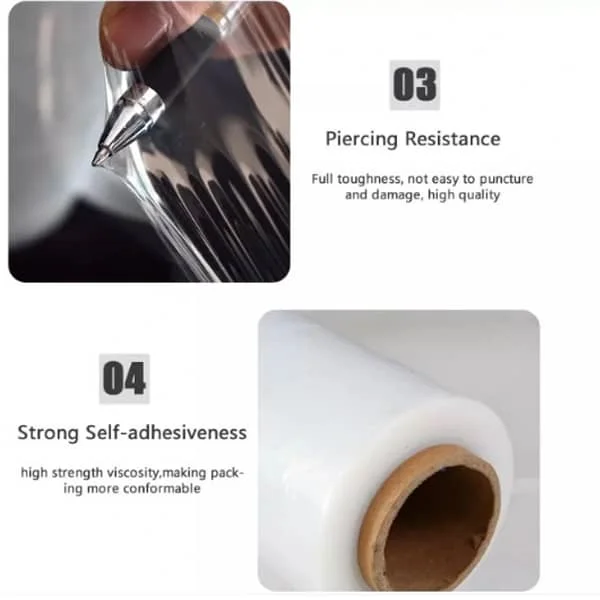
Puncture and Tear Resistance
Puncture resistance is important for pallets with sharp corners, protrusions or irregular products. Tear resistance determines how the film behaves after a small cut or puncture develops.
Loads containing metal components, timber, construction materials or irregular cartons usually require more attention to puncture performance.
Cling
Cling enables overlapping film layers to remain attached. Depending on the formulation, film may have cling on one side or both sides.
Incorrect cling orientation can cause adjacent pallets to stick together or may allow the wrap to loosen. Buyers should confirm whether they require one-sided or two-sided cling.
Clarity
High film clarity makes it easier to scan barcodes, read carton labels and inspect products without removing the wrapping.
Clear film is commonly used in distribution centers and inventory-controlled environments. Colored or opaque film is more suitable when concealment or visual identification is required.
Load Retention
Load retention describes the film’s ability to maintain containment over time. It is particularly important for long-distance transportation, repeated handling and loads that may settle after wrapping.
A film that initially feels tight may still lose effectiveness if it relaxes excessively during storage.
How to Choose the Right Stretch Film
1. Evaluate the Pallet Load
Begin by identifying the load type:
Uniform or irregular
Lightweight or heavy
Stable or unstable
Compressible or rigid
Smooth or sharp-edged
Short-distance or export shipment
Uniform cartons on a well-built pallet generally require less puncture resistance than mixed products with protruding edges.
2. Confirm the Application Method
Determine whether the film will be applied manually or by machine.
For machine wrapping, record:
Wrapping machine brand and model
Pre-stretch percentage
Turntable or rotary-arm configuration
Wrapping speed
Film carriage type
Current film breakage problems
These details allow the supplier to recommend a compatible machine-grade film.
3. Measure Pallet Dimensions and Weight
Provide the pallet length, width, height and gross weight. An unusually tall, narrow or top-heavy load may require a different wrapping pattern or film performance level.
4. Review Transport Conditions
A pallet transported locally under controlled conditions has different requirements from an export pallet exposed to repeated loading, vibration, humidity and temperature changes.
Important considerations include:
Transport distance
Number of handling stages
Road or sea freight
Outdoor storage
Warehouse temperature
Pallet stacking
Moisture and dust exposure
5. Calculate Total Packaging Cost
The lowest roll price does not necessarily produce the lowest packaging cost.
Evaluate:
Film weight used per pallet
Number of film breaks
Wrapping time
Labor cost
Product damage
Pallet rejection or rewrapping
Machine downtime
Disposal volume
A more efficient film may carry a higher price per kilogram while reducing the total cost per secured pallet.
6. Conduct a Pallet Trial
Samples should be tested under actual operating conditions. A useful trial compares the existing film with the proposed film on the same product, machine and wrapping pattern.
Record:
Film weight per pallet
Number of wraps
Film breaks
Wrapping time
Load movement
Corner damage
Condition after transport
Foshan JYE Packaging Materials Co., Ltd supports sample testing, specification matching, remote technical consultation or on-site pallet trials for qualified projects. Customers can send their current film data and pallet information to receive a more accurate recommendation.
Common Stretch Film Applications
Food and Beverage
It secures cartons, bottles, cans and packaged foods during warehouse handling and delivery. Film clarity and load stability are often important for these applications.
Logistics and Distribution
Distribution centers use stretch film to consolidate mixed cartons, protect shipments and reduce load movement between warehouse locations.
Building Materials
Tiles, profiles, boards, hardware and other construction materials may require films with strong puncture and tear resistance.
Electronics and Appliances
Stretch film protects cartons from dust and light moisture while keeping pallet labels visible.
Paper and Printing
Paper rolls, cartons and printed products require protection from contamination and shifting during transportation.
Industrial Components
Automotive parts, metal products, machinery components and molded goods often require customized film thickness, puncture resistance or wrapping patterns.
How to Reduce Stretch Film Consumption
Film reduction should not mean weakening pallet stability. The objective is to use the minimum amount of film needed to achieve safe containment.
Practical measures include:
Standardize the wrapping pattern for each load type.
Train operators to apply consistent tension and overlap.
Maintain machine rollers and pre-stretch components.
Use corner boards where sharp edges repeatedly puncture the film.
Improve pallet stacking before adding more film.
Test downgauged or high-performance film under controlled conditions.
Measure consumption by pallet rather than by roll.
Review damaged shipments and film-break records regularly.
Stretch Film and Sustainable Packaging
Sustainable stretch-film purchasing should consider material usage, packaging efficiency and waste management.
Possible strategies include:
Reducing film weight per pallet
Selecting high-performance downgauged film
Using film containing recycled material where appropriate
Improving pallet stability to reduce damaged goods
Separating used polyethylene film for recycling
Optimizing roll length and packaging to reduce transport frequency
Ask the supplier to explain the recycled-content percentage, source of the material and expected performance variation.
Why Work With Foshan JYE Packaging Materials Co., Ltd ?
Choosing a stretch film supplier involves more than comparing quotations. Product consistency, technical communication and supply reliability can directly affect packaging operations.
Foshan JYE Packaging Materials Co., Ltd is a manufacturer/exporter/supplier based in Foshan China, specializing in stretch film products.
Our capabilities include:
2 production lines
Film widths from 100-1500mm
Thickness options from 15-40microns
Hand, machine, pre-stretched, colored or customized films
Customized roll weight, core size, packaging and carton printing
OEM and private-label production
Commercial support for samples, quotations and shipping documentation
Information to Include in a Stretch Film Inquiry
To receive an accurate quotation, provide:
Film type: hand or machine
Film width
Required thickness
Roll length or net film weight
Core size
Film color
One-sided or two-sided cling
Required stretch level
Pallet dimensions and weight
Product type
Wrapping machine model
Monthly or annual quantity
Delivery country and port
Required certification
Packaging or private-label requirements
Photographs or videos of the pallet and wrapping process can also help the supplier identify potential problems.
Frequently Asked Questions About Stretch Film
What is the difference between stretch film and stretch wrap?
There is no significant difference. “Stretch film” and “stretch wrap” . “Pallet wrap” usually refers specifically to film used for palletized loads.
Is thicker stretch film always stronger?
Not necessarily. Thickness affects performance, but resin quality, layer construction, extrusion control and film formulation are also important. Compare tested performance and film consumption per pallet rather than relying only on nominal thickness.
What causes stretch film to break during wrapping?
Common causes include excessive tension, damaged film edges, incorrect machine settings, sharp pallet corners, poor roll storage, unsuitable film specifications and worn pre-stretch rollers.
Can stretch film protect goods from rain?
Stretch film can offer limited protection against dust and moisture, but standard pallet wrapping is not always completely waterproof.
Is stretch film recyclable?
Clean polyethylene stretch film may be recyclable where suitable collection and recycling facilities exist.
Can stretch film be customized?
Yes. Depending on production capability and order quantity, suppliers may customize width, thickness, roll weight, core size, color, cling, packaging, labels and printed cartons.
Conclusion
The right stretch film should secure the pallet, protect the product and control packaging costs throughout storage and transportation. Effective selection requires more than choosing a thickness or comparing price per roll.
Buyers should evaluate the load, wrapping method, machine settings, transport conditions and total film consumption. Conducting a controlled pallet trial is the most reliable way to confirm whether a film performs correctly.
For product specifications, samples or a customized quotation, contact Foshan JYE Packaging Materials Co., Ltd :
Website: https://www.jyestretchwrap.com/
Send us your current stretch film specification, pallet dimensions, load weight and estimated order quantity. Our team will recommend a suitable stretch wrapping solution for your application.