

How to Choose Stretch Film for Heavy Pallet Loads
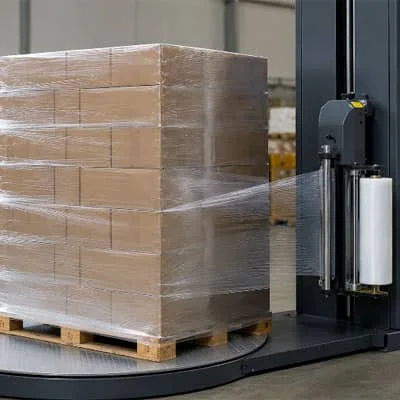
Choosing the right stretch film for heavy pallet loads requires looking at the complete load, not just its total weight.
A dense pallet of uniform cartons may be easier to stabilize than a lighter pallet containing irregular metal parts. A 2,000 lb pallet with smooth, tightly stacked boxes may require a very different film from a pallet of machinery components with sharp edges and uneven weight distribution.
This guide explains the main factors to consider when selecting stretch film for heavy pallets and how to avoid both under-packaging and unnecessary film use.
What Is Considered a Heavy Pallet Load?
There is no single universal weight at which a pallet becomes a “heavy load.”
In practical packaging operations, the difficulty of securing a pallet depends on several factors:
- total pallet weight;
- height of the load;
- weight distribution;
- product shape;
- carton or package stability;
- presence of sharp corners;
- pallet overhang;
- transportation distance;
- handling frequency.
For example, a short pallet containing tightly packed bags may be heavy but relatively stable.
A tall pallet of mixed cartons may weigh less but move much more during acceleration, braking, forklift handling, and road transport.
This is why load stability is often more important than pallet weight alone.
Stretch film contributes to unit-load stability through the force it maintains around the palletized products. In packaging practice, this is often discussed in terms of containment force. Research and industry standards also distinguish between simply measuring film properties and evaluating how a film actually performs once applied to a complete unit load.
Before choosing a film, first ask:
Is the problem that the pallet is heavy, or is the problem that the pallet is difficult to contain?
The answer may change the type of stretch film you need.
1. Start With the Shape and Stability of the Load
The first step is to classify the pallet.
Uniform Loads
A uniform load has:
- similar-sized cartons;
- straight vertical sides;
- limited overhang;
- even weight distribution;
- few sharp edges.
These loads are generally easier to wrap because the stretch film can maintain relatively even contact with the surface.
A heavy but uniform pallet may not always require an extremely thick film.
Instead, good film performance combined with the correct wrapping pattern may provide sufficient stability.
Irregular Loads
Irregular loads are more difficult.
Examples include:
- machinery components;
- metal products;
- automotive parts;
- furniture;
- building materials;
- products with different carton sizes;
- mixed SKU pallets.
The film must stretch around uneven surfaces without tearing and continue holding the load during transportation.
For these applications, puncture resistance and tear propagation resistance can become more important than simply selecting a higher nominal thickness.
Sharp-Edged Loads
Products with exposed corners or protrusions create concentrated stress points.
Typical examples include:
- metal components;
- timber;
- profiles;
- industrial equipment;
- cartons with very rigid corners.
When conventional film is pulled tightly around these areas, a small puncture can develop into a larger tear.
For this type of pallet, consider:
- a tougher stretch film formulation;
- heavier-duty film;
- blown stretch film where higher puncture resistance is required;
- corner protectors;
- edge protection;
- additional reinforcement around critical areas.
Do not rely on film thickness alone to solve a severe sharp-edge problem.
Sometimes a small amount of edge protection reduces film failure more effectively than simply applying more plastic.
2. Choose the Right Stretch Film Thickness
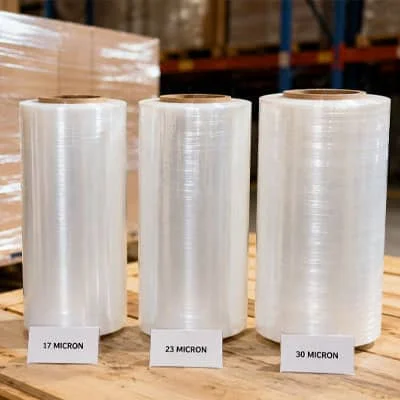
Thickness is important, but it should be treated as one selection factor rather than the entire specification.
Stretch film thickness is commonly expressed in:
- microns;
- gauge
A thicker film will generally contain more material per unit area. Depending on the film formulation and manufacturing process, this can provide greater resistance to demanding applications.
However:
Two stretch films with the same thickness do not necessarily perform the same way.
Film formulation, resin quality, layer structure, elongation, puncture resistance, and manufacturing consistency all affect actual performance.
That is why selecting a stretch film only by asking for “20 micron” or “25 micron” can lead to inconsistent results.
Your existing thickness guide correctly treats thickness as one part of the selection process rather than a complete performance guarantee.
A Practical Starting Point
For general pallet wrapping, mid-range films are widely used.
For more demanding applications involving:
- heavy pallets;
- long-distance transportation;
- irregular cargo;
- higher puncture risk;
buyers often evaluate heavier-duty specifications, including films in the 25–30 micron range, depending on the film type and application system. Your existing micron-selection guide uses this range as a practical option for heavy or demanding pallet applications, while the final choice still depends on the actual load.
3. Evaluate Puncture Resistance, Not Just Film Thickness
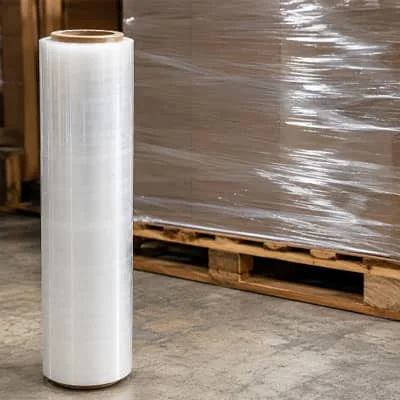
Heavy loads often create high local stress on the film.
This is especially true when the pallet contains:
- sharp carton corners;
- metal edges;
- protruding parts;
- irregularly shaped products;
- gaps between packages.
Imagine wrapping two pallets with the same 25 micron film.
The first pallet contains smooth cardboard cartons.
The second contains metal components with exposed edges.
Although the pallet weight may be identical, the second application creates a much greater risk of puncture.
This is where the film structure becomes important.
A good heavy-duty stretch film should be able to:
- stretch around load contours;
- resist puncture during application;
- avoid rapid tear propagation;
- maintain holding force after wrapping.
4. Decide Between Cast and Blown Stretch Film
Both cast and blown stretch films can be used for pallet wrapping, but their characteristics are different.
Your choice should depend on the load and operating environment.
Cast Stretch Film
Cast stretch film is commonly selected for applications where users value:
- good clarity;
- smooth and quiet unwinding;
- consistent film quality;
- efficient machine application;
- high-volume pallet wrapping.
It is widely used for regular pallet loads and automated packaging operations.
For heavy but uniform pallets, a correctly specified cast stretch film can be an efficient solution.
Blown Stretch Film
Blown stretch film is often considered for more demanding applications where toughness and puncture resistance are priorities.
It may be useful for:
- irregular loads;
- sharp-edged products;
- demanding transportation;
- rough handling environments.
The correct choice still depends on the actual film formulation. “Blown” does not automatically mean that every blown film is stronger than every cast film.
The more accurate comparison is:
Which specific film performs better on your actual load and wrapping system?
For a more detailed comparison, see:
Cast vs Blown Stretch Film: Key Differences, Uses & Buying Guide
Your current comparison article also correctly notes that both cast and blown film can be produced for hand or machine applications, so manufacturing process and application method should not be confused.
5. Choose Hand Stretch Film or Machine Stretch Film
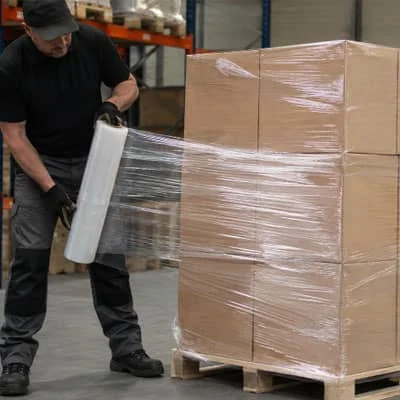
The correct application method becomes increasingly important as pallet volume and load weight increase.
Hand Stretch Film
Hand stretch film is suitable when:
- pallet volume is relatively low;
- loads vary frequently;
- wrapping locations change;
- a wrapping machine is not available;
- operators need flexibility.
For occasional heavy pallets, a heavy-duty hand stretch film may be appropriate.
However, manual wrapping introduces operator variation.
Two workers may apply:
- different tension;
- different numbers of film revolutions;
- different overlap;
- different reinforcement at the pallet base.
As a result, packaging consistency can vary from pallet to pallet.
For manual heavy-load applications, establishing a standard wrapping procedure is important.
You can also naturally link to your product page here:
Heavy Duty Hand Stretch Wrap Film
Your existing product positioning describes this film for manual pallet packaging, cargo bundling, warehouse storage, and shipping protection.
Machine Stretch Film
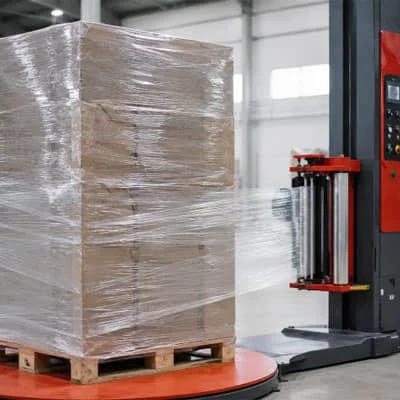
Machine stretch film is usually the better option when:
- many pallets are wrapped every day;
- load containment must be repeatable;
- high film stretch is required;
- labor efficiency matters;
- consistent wrapping is important.
For repeated heavy pallet wrapping, machine application can provide more controlled film delivery and more consistent results than manual wrapping.
Your current hand-versus-machine guide similarly positions machine stretch film as particularly suitable for repeated heavy pallet wrapping where controlled application and consistent containment are important.
See also:
Hand vs Machine Stretch Film: Key Differences and Uses
6. Do Not Ignore Pre-Stretch
A common misunderstanding is that more film automatically creates a stronger pallet.
That is not always true.
Stretch film is designed to be stretched during application.
When the film is properly stretched and applied, its elastic recovery helps maintain force around the pallet.
If the film is applied incorrectly, several problems can occur:
- too little stretch may reduce packaging efficiency;
- excessive tension may damage products;
- inconsistent tension may produce unstable wrapping;
- poor machine settings may waste film.
Research on palletized stretch wrapping has examined the relationship between pre-stretch, containment force, and unit-load performance, reinforcing the point that the application process matters alongside the film itself.
For machine wrapping, check:
- pre-stretch capability;
- film tension settings;
- carriage condition;
- wrapping speed;
- film compatibility.
A premium machine stretch film cannot perform properly if the wrapping machine is poorly adjusted.
7. Use the Correct Wrapping Pattern
Even the right film can fail when applied incorrectly.
For heavy pallet loads, pay particular attention to three areas.
Secure the Base
The products and pallet need to function as one unit.
If the bottom of the load is not adequately secured, the goods may move independently from the pallet.
Make sure the wrapping pattern properly engages the lower part of the load and pallet where appropriate.
Reinforce Critical Areas
Some pallets need more reinforcement at:
- the bottom;
- the top;
- unstable layers;
- areas with irregular products.
Applying exactly the same number of wraps to every part of every pallet is not always the best approach.
Maintain Adequate Overlap
Each film revolution should overlap the previous layer enough to create an effective wrapped structure.
Insufficient overlap can leave weak zones.
Excessive overlap, however, may simply increase film consumption.
The goal is repeatable containment—not the maximum possible number of film layers.
8. Consider the Transportation Environment
A pallet that moves 100 meters inside a warehouse does not experience the same conditions as a pallet shipped internationally.
Before selecting stretch film, consider the complete distribution route.
Warehouse Storage
For pallets stored in a controlled warehouse, the main requirements may be:
- dust protection;
- load organization;
- basic stability.
Domestic Truck Transportation
Road transportation introduces:
- acceleration;
- braking;
- vibration;
- cornering forces;
- repeated handling.
The pallet must remain stable throughout the journey.
Long-Distance and Export Shipping
Long-distance supply chains may involve:
- multiple warehouses;
- forklifts;
- trucks;
- ports;
- containers;
- repeated loading and unloading.
A film specification that works for internal warehouse movement may not be sufficient for this environment.
ASTM guidance and test methods exist for evaluating stretch-wrap films and unit-load behavior, including the effects of impact and load containment, but practical performance still depends on the complete pallet system and actual distribution conditions.
For demanding shipping routes, test the complete wrapped load under conditions that reasonably represent actual handling.
9. Check Whether the Load Itself Needs Improvement
Sometimes the stretch film is not the real problem.
Before moving to a thicker film, inspect the pallet.
Look for:
- cartons hanging over the pallet;
- empty spaces between products;
- poor stacking patterns;
- unstable top layers;
- crushed cartons;
- uneven weight distribution;
- damaged pallets.
Stretch film cannot completely compensate for a poorly built unit load.
For example, if cartons extend beyond the edge of the pallet, they are more exposed to impact and can create difficult corners for the film.
Improving the pallet configuration may allow you to:
- use less film;
- reduce punctures;
- improve stability;
- reduce transport damage.
A better pallet plus the correct film is usually more effective than simply adding more layers of stretch wrap.
10. Test the Film on the Actual Pallet
For heavy pallet loads, a real application trial is one of the most important steps in film selection.
A useful trial should compare more than whether the pallet “looks tight.”
Evaluate:
- film breaks during wrapping;
- punctures around corners;
- load movement;
- film consumption per pallet;
- wrapping time;
- stability after storage;
- condition after transportation.
If possible, compare several film specifications under the same conditions.
For example:
| Test | Film A | Film B | Film C |
| Thickness | 20 micron | 25 micron | 30 micron |
| Film breaks | 2 | 1 | 1 |
| Film used per pallet | Low | Medium | High |
| Load stability | Fair | Good | Good |
| Total packaging cost | Low | Moderate | High |
This is why stretch film should be evaluated based on:
performance per pallet, not simply price per kilogram or price per roll.
Common Mistakes When Choosing Stretch Film for Heavy Loads
Mistake 1: Choosing Film Only by Pallet Weight
Weight matters, but load shape and stability can matter just as much.
Mistake 2: Assuming Thicker Is Always Better
A thicker film may increase material use without solving poor wrapping technique or unstable pallet construction.
Mistake 3: Comparing Only Price Per Roll
Different rolls may have different:
- thicknesses;
- widths;
- lengths;
- net film weights;
- stretch performance.
A cheaper roll is not necessarily cheaper per wrapped pallet.
Mistake 4: Ignoring the Wrapping Machine
Incorrect machine settings can cause:
- film breaks;
- poor stretching;
- unstable loads;
- unnecessary film consumption.
Mistake 5: Skipping Real-World Testing
A technical data sheet is useful, but the final test is performance on your own products, pallets, equipment, and transport route.
Quick Selection Guide
| Load Condition | What to Consider |
| Heavy, uniform cartons | Consistent stretch and containment |
| Heavy, irregular load | Toughness and puncture resistance |
| Sharp-edged products | Puncture-resistant film plus edge protection |
| Low-volume wrapping | Heavy-duty hand stretch film |
| High-volume wrapping | Machine stretch film |
| Long-distance shipping | Stronger, validated wrapping system |
| Tall unstable pallets | Load stability and wrapping pattern |
| Repeated film breaks | Film specification, edges, tension, and machine settings |
How to Choose the Best Stretch Film for Your Heavy Pallet
A practical selection process looks like this:
Step 1: Define the pallet
Record:
- total weight;
- dimensions;
- height;
- product type.
Step 2: Check the load shape
Determine whether the load is:
- uniform;
- irregular;
- sharp-edged;
Step 3: Choose the application method
Decide between:
- hand stretch film;
- machine stretch film.
Step 4: Select an initial film specification
Consider:
- thickness;
- film type;
- puncture resistance;
- stretch performance.
Step 5: Establish a wrapping pattern
Standardize:
- base wraps;
- overlap;
- reinforcement;
- top wraps.
Step 6: Run a pallet trial
Observe film behavior during wrapping and transportation.
Step 7: Optimize
Use the lowest practical amount of film that consistently provides the required load stability.
Frequently Asked Questions
What thickness of stretch film is best for heavy pallets?
There is no single thickness that is best for every heavy pallet.
For demanding loads, thicker heavy-duty films may be evaluated, and 25–30 micron film is a common practical range to consider for heavy, irregular, or long-distance shipping applications. However, load shape, sharp edges, film formulation, wrapping method, and transport conditions should also be considered. Your existing micron guide uses the same range as a practical recommendation rather than a universal rule.
Is 20 micron stretch film strong enough for heavy pallets?
It can be, depending on the film quality and load.
A stable pallet of uniform cartons may perform well with a high-performance 20 micron film, while an irregular pallet with sharp metal edges may require a tougher or heavier film.
Test the film on the actual pallet before making a volume purchase.
Is blown stretch film better for heavy loads?
Blown stretch film is often selected for demanding or irregular loads because puncture and tear resistance can be important.
However, high-performance cast stretch films can also be used for heavy pallet wrapping.
The best choice depends on the specific film and application.
Should I use hand or machine stretch film for heavy pallets?
For occasional or low-volume wrapping, heavy-duty hand stretch film can be suitable.
For repeated heavy pallet wrapping or high-volume operations, machine stretch film usually provides greater consistency and process control.
How many layers of stretch wrap are needed for a heavy pallet?
There is no universal number.
The correct number depends on:
- film type;
- film thickness;
- applied stretch;
- pallet height;
- load stability;
- wrapping pattern.
The goal should be sufficient and repeatable load containment rather than simply applying as many layers as possible.
Why does stretch film keep breaking on heavy pallets?
Common causes include:
- sharp corners;
- excessive tension;
- incorrect machine settings;
- damaged film rolls;
- insufficient puncture resistance;
- poor pallet configuration.
Before increasing film thickness, identify where and why the film is breaking.
Final Thoughts
Choosing the right stretch film for heavy pallet loads is not simply a matter of buying the thickest roll.
The most reliable solution comes from matching the film to:
- the weight of the pallet;
- the shape of the load;
- puncture risk;
- wrapping method;
- transportation conditions;
- required load stability.
The best approach is to begin with a suitable specification, test it on the actual pallet, and optimize based on real packaging performance.
JYE Stretch Wrap supplies hand and machine stretch film for different pallet wrapping applications. When selecting film for a heavy or difficult load, providing information such as pallet weight, dimensions, product type, wrapping method, and shipping conditions can help identify a more appropriate starting specification.
Explore our pallet wrapping film options:
https://jyestretchwrap.com/product/pallet-wrapping-films-manufacturer/