

How to Choose Stretch Film Thickness: A Practical Guide for Buyers
Choosing the right stretch film thickness is not only about buying a “stronger” film. In many cases, using a film that is too thick increases packaging cost without improving pallet stability. Using a film that is too thin may cause film breakage, poor load containment, product damage, or higher labor waste. For purchasing teams, warehouse managers, and distributors, the correct choice should be based on load weight, pallet shape, product edge sharpness, wrapping method, transport distance, and required stretch performance.
This guide explains how to choose stretch film thickness, width, stretch rate, and specifications for different packaging applications.
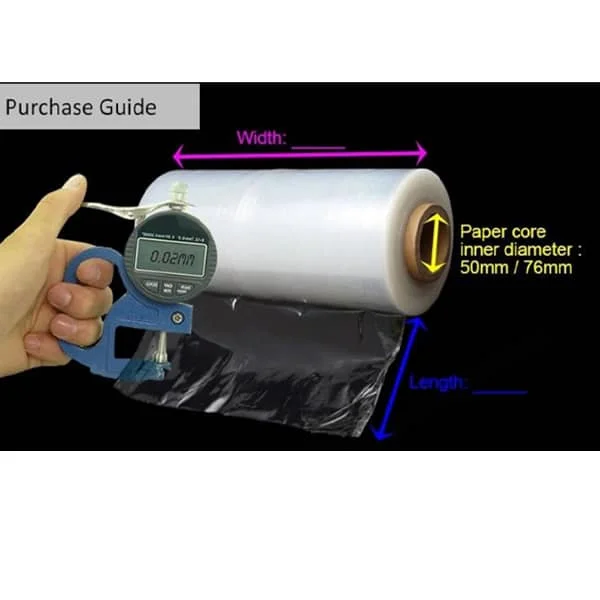
1. What Does Stretch Film Thickness Mean?
Stretch film thickness refers to the film gauge or micron level. It determines the basic strength, puncture resistance, tear resistance, and load-holding capacity of the film.
Common thickness units include:
- Micron / μm: commonly used in Asia, Europe, and international trade.
- Gauge: commonly used in the United States.
- Mil: also used in North America.
Basic conversion:
| Micron | Gauge | Mil | Typical Use |
|---|---|---|---|
| 12 μm | 48 gauge | 0.48 mil | Light cartons, clean warehouse use |
| 15 μm | 60 gauge | 0.60 mil | Regular hand wrapping |
| 17 μm | 67 gauge | 0.67 mil | General pallet packaging |
| 20 μm | 80 gauge | 0.80 mil | Medium-heavy goods |
| 23 μm | 90 gauge | 0.90 mil | Heavy or irregular loads |
| 25 μm | 100 gauge | 1.00 mil | Heavy-duty wrapping |
| 30 μm | 120 gauge | 1.20 mil | Sharp, unstable, or export pallets |
A common mistake is assuming thicker film is always better. Thickness is only one factor. A high-quality 17 μm stretch film with good stretch rate and puncture resistance may perform better than a low-quality 23 μm film.
2. Common Stretch Film Specifications
Before choosing thickness, buyers should understand the common specifications used in the stretch film market.
Hand Stretch Film
Typical specifications:
- Thickness: 12–25 μm
- Width: 300 mm, 400 mm, 450 mm, 500 mm
- Length: 200 m, 300 m, 500 m
- Core size: usually 2 inch or 3 inch
- Application: manual pallet wrapping, small warehouses, furniture, cartons, logistics packaging
Common hand film sizes:
- 500 mm × 17 μm × 300 m
- 500 mm × 20 μm × 300 m
- 450 mm × 15 μm × 300 m
- 500 mm × 23 μm × 300 m
For manual wrapping, film should not be too thick. If the film is too heavy or difficult to stretch by hand, workers may use less tension, which reduces pallet stability.
Machine Stretch Film
Typical specifications:
- Thickness: 15–30 μm
- Width: usually 500 mm
- Length: 1000 m, 1500 m, 1800 m, 2000 m
- Stretch rate: usually 150%–300%, depending on machine and film grade
- Application: automatic or semi-automatic pallet wrapping
Common machine film sizes:
- 500 mm × 17 μm × 1500 m
- 500 mm × 20 μm × 1500 m
- 500 mm × 23 μm × 1500 m
- 500 mm × 25 μm × 1500 m
Machine film should be selected according to the pre-stretch ability of the wrapping machine. If the machine can pre-stretch 250%, buying low-grade film that breaks at 120% stretch is a poor purchasing decision.
Jumbo Roll Stretch Film
Typical specifications:
- Thickness: 12–30 μm
- Width: 500 mm, 1000 mm, 1500 mm
- Weight: often 30 kg, 50 kg, or customized
- Application: rewinding into hand rolls or machine rolls
Jumbo roll buyers should pay attention to net film weight, paper core weight, roll flatness, and thickness tolerance. Some suppliers quote low prices by increasing core weight or reducing actual film length.
3. How to Choose Stretch Film Thickness by Load Type
The most practical way to choose thickness is to look at the product being wrapped.
Light Loads: 12–15 μm
Suitable for:
- Small cartons
- Tissue paper, plastic products, foam products
- Light e-commerce goods
- Clean warehouse storage
- Short-distance transportation
Recommended film:
- 12 μm or 15 μm hand stretch film
- Width: 450 mm or 500 mm
- Stretch rate: 100%–150% for hand use
Do not use very thin film if the pallet has sharp carton corners or unstable stacking. Thin film saves cost only when the load is regular and low-risk.
Medium Loads: 17–20 μm
Suitable for:
- General cartons
- Beverage cartons
- Household goods
- Textile products
- Regular export pallets
- Warehouse-to-warehouse transportation
Recommended film:
- 17 μm for standard loads
- 20 μm for stronger containment
- Width: 500 mm
- Stretch rate: 150%–250% depending on film grade
This is the most common range for pallet wrapping. For many distributors and factories, 17 μm and 20 μm are the safest starting points because they balance cost, strength, and usability.
Heavy Loads: 23–25 μm
Suitable for:
- Building materials
- Metal parts
- Machinery components
- Canned goods
- Heavy cartons
- Export pallets with long-distance transport
Recommended film:
- 23 μm for heavy but regular pallets
- 25 μm for higher puncture resistance
- Width: 500 mm
- Stretch rate: 180%–250% for machine film
Heavy loads require better holding force. If the pallet shifts during transport, the problem may not be only film thickness. It may also involve poor wrapping pattern, weak bottom locking, insufficient overlap, or low film tension.
Extra Heavy or Irregular Loads: 25–30 μm
Suitable for:
- Sharp-edged products
- Pipes, profiles, hardware, ceramic tiles
- Irregular pallet shapes
- Long export shipping
- Outdoor or rough handling conditions
Recommended film:
- 25 μm, 28 μm, or 30 μm
- Consider high-puncture cast stretch film or blown stretch film
- Use reinforced wrapping at bottom and top layers
For these loads, do not choose film only by price per roll. You should calculate cost per wrapped pallet and damage rate. A cheaper thin film may cause more breakage, more wrapping layers, and higher total cost.
4. How Width Affects Stretch Film Performance
Stretch film width affects wrapping speed, coverage, and overlap. The most common width is 500 mm, but other widths are also used.
500 mm Width
This is the standard width for most pallet wrapping. It offers good coverage and is compatible with most hand dispensers and wrapping machines.
Best for:
- Standard pallets
- Carton packaging
- Warehouse use
- Export shipments
450 mm Width
This width is common for manual wrapping. It is slightly easier to handle and may reduce worker fatigue.
Best for:
- Hand wrapping
- Smaller pallets
- Light and medium loads
300 mm Width
This is used for bundling rather than full pallet wrapping.
Best for:
- Small items
- Pipe bundling
- Profile bundling
- Furniture parts
- Hardware packaging
1000 mm or 1500 mm Width
Usually used for jumbo rolls or special industrial wrapping.
Best for:
- Rewinding factories
- Large products
- Special packaging lines
A common mistake is choosing narrow film for large pallets to reduce roll price. This often increases labor time and overlap waste. For normal pallets, 500 mm is usually more efficient.
5. Stretch Rate: Why It Matters More Than Many Buyers Think
Stretch rate means how much the film can be stretched before or during application.
Example:
If 1 meter of film is stretched to 2.5 meters, the stretch rate is 150%. Some people also describe this as 250% elongation depending on calculation method, so buyers should confirm the supplier’s definition.
Typical stretch performance:
| Film Type | Typical Stretch Rate |
|---|---|
| Hand stretch film | 100%–150% |
| Economy machine film | 150%–200% |
| Standard machine film | 200%–250% |
| High-performance machine film | 250%–300%+ |
For hand wrapping, extremely high stretch rate is not always useful because workers cannot apply consistent force. For machine wrapping, stretch rate is critical because pre-stretch reduces film consumption per pallet.
Example:
If a machine stretch film can be pre-stretched properly, one roll may wrap significantly more pallets than a cheaper low-stretch film. So the correct purchasing comparison is not only price per kg or price per roll, but also:
- Film used per pallet
- Number of pallets wrapped per roll
- Breakage rate during wrapping
- Product damage rate during transport
- Labor or machine downtime
A low-price film that breaks frequently is not cheap.
6. Application Scenarios and Recommended Thickness
Warehouse Storage
Recommended:
- 15–17 μm
- Width: 450–500 mm
- Focus: dust protection, basic load stability
For goods stored indoors with little movement, high thickness is usually unnecessary.
Domestic Logistics
Recommended:
- 17–20 μm
- Width: 500 mm
- Focus: load stability, carton protection, cost balance
Domestic transport normally requires stronger film than simple warehouse storage because pallets face vibration, forklift handling, and repeated loading.
Export Pallet Packaging
Recommended:
- 20–25 μm
- Width: 500 mm
- Focus: long-distance stability, humidity protection, handling resistance
For export shipments, the film should maintain tension over time. If the goods are heavy or high-value, do not use ultra-thin film just to reduce packaging cost.
Beverage and Canned Goods
Recommended:
- 20–25 μm
- Width: 500 mm
- Focus: high holding force
These loads are heavy and may shift if the film has poor containment force.
Furniture and Household Products
Recommended:
- 17–23 μm
- Width: 450–500 mm
- Focus: surface protection and puncture resistance
For furniture edges, consider corner protectors. Do not expect stretch film alone to solve sharp-edge damage.
Metal, Hardware, and Building Materials
Recommended:
- 23–30 μm
- Width: 500 mm
- Focus: puncture resistance and tear resistance
Use thicker film or high-puncture film. If corners are sharp, add cardboard edge protectors before wrapping.
7. Hand Film vs Machine Film: Do Not Mix Them Randomly
Hand stretch film and machine stretch film are not the same.
Hand film should be easy to pull, light enough for workers, and stable during manual wrapping. Machine film must tolerate higher stretch, faster wrapping speed, and pre-stretch rollers.
Common mistake:
A buyer uses hand film on a wrapping machine because it is cheaper. The result is often film breakage, unstable tension, and poor pallet containment.
Another mistake:
A buyer uses machine film manually. It may be too hard to stretch by hand, causing worker fatigue and loose wrapping.
Choose film according to the actual wrapping method, not only according to thickness.
8. Purchasing Advice: How to Compare Stretch Film Suppliers
When sourcing stretch film, do not compare only unit price. Ask suppliers for complete specifications.
Fo shan JYE Packaging Materials Co., Ltd quotation should include:
- Material: LLDPE, metallocene LLDPE, or blended material
- Film type: cast stretch film or blown stretch film
- Thickness: for example, 17 μm, 20 μm, 23 μm
- Width: for example, 500 mm
- Length: for example, 300 m or 1500 m
- Net film weight
- Core weight
- Roll weight
- Stretch rate
- Puncture resistance level
- Packing method
- Quantity per carton or pallet
- MOQ
- Lead time
You should also request samples before placing a large order. Test the film on your actual products, not only by pulling it by hand. Manual pulling cannot accurately show pallet containment performance.
For machine film, test it directly on your wrapping machine. Check:
- Does the film break during pre-stretch?
- Is the pallet stable after wrapping?
- Does the film cling properly?
- Is the film too noisy?
- Does it leave residue?
- How many pallets can one roll wrap?
- Does the roll unwind smoothly?
The best film is not necessarily the thickest one. The best film is the one that achieves stable packaging at the lowest total cost per pallet.
9. Common Mistakes When Choosing Stretch Film Thickness
Mistake 1: Buying Only by Price Per Roll
A roll with shorter length, thicker core, or lower net film weight may look cheaper but cost more in actual use. Always compare net film weight and usable film length.
Mistake 2: Assuming Thicker Film Always Means Better Film
Poor-quality thick film may have weak stretch, low cling, and poor puncture resistance. Film formulation and production quality matter.
Mistake 3: Ignoring Load Shape
Regular cartons and irregular metal parts do not need the same film. Sharp edges require puncture resistance, not just basic thickness.
Mistake 4: Ignoring Wrapping Method
Hand wrapping, semi-automatic wrapping, and automatic wrapping require different film performance. A film that works well by hand may fail on a high-speed machine.
Mistake 5: Using Too Few Wrapping Layers
Even with good film, poor wrapping technique can cause failure. The bottom of the pallet should be locked properly, and overlap should be consistent.
Mistake 6: Not Testing Film Under Real Transport Conditions
A pallet may look stable in the warehouse but fail during truck vibration or sea shipment. For export packaging, test stability after movement, not only immediately after wrapping.
10. Quick Selection Guide
Use this as a starting point:
| Application | Recommended Thickness | Width | Film Type |
|---|---|---|---|
| Light cartons | 12–15 μm | 450–500 mm | Hand film |
| General warehouse use | 15–17 μm | 450–500 mm | Hand or machine film |
| Standard pallet wrapping | 17–20 μm | 500 mm | Hand or machine film |
| Medium-heavy goods | 20–23 μm | 500 mm | Machine film preferred |
| Heavy export pallets | 23–25 μm | 500 mm | Machine stretch film |
| Sharp or irregular loads | 25–30 μm | 500 mm | Heavy-duty film |
Conclusion
Choosing stretch film thickness should be based on the actual packaging problem, not simply on roll price or film thickness. For light and regular goods, 12–15 μm may be enough. For standard pallet wrapping, 17–20 μm is usually the most practical range. For heavy, sharp, or export goods, 23–30 μm offers better puncture resistance and load stability.
A good purchasing decision should consider thickness, width, stretch rate, film type, wrapping method, load weight, pallet shape, and transport conditions. Before buying in bulk, test samples on real pallets and calculate the cost per successfully wrapped pallet. That is the only reliable way to choose the right stretch film.
Fo shan JYE Packaging Materials Co., Ltd provides customized stretch film solutions based on load type, wrapping method, thickness, width, stretch rate, and transport needs, helping customers reduce packaging cost and improve pallet stability.