

Stretch Film Thickness Guide: How to Choose the Right Gauge for Your Pallet
Choosing the wrong stretch film thickness is one of the most common — and most expensive — mistakes in pallet packaging. Go too thin, and your loads shift or fail in transit. Go too thick, and you waste material and money on every single pallet you wrap.
This guide breaks down what stretch film thickness actually means, how the different measurement units relate to one another, and how to pick the right gauge for your specific application — from light hand-wrapped retail boxes to heavy industrial pallets running through an automatic wrapper.
Why Stretch Film Thickness Matters
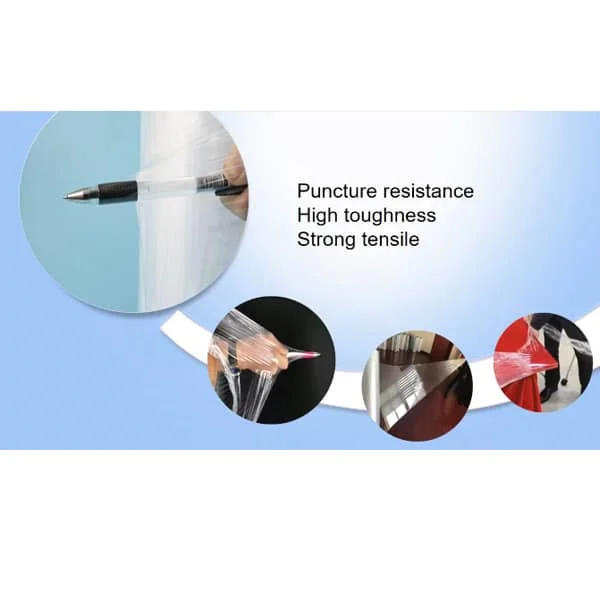
Stretch film thickness determines three things at once: how much weight the film can safely hold, how resistant it is to punctures and tears, and how much it costs you per pallet. There’s no single “correct” thickness, because no one film performs equally well across every load type.
A film that’s too thin for a heavy or sharp-edged load will tear during wrapping or loosen in transit — leading to product damage, returns, and costly rework. A film that’s thicker than necessary adds unneeded material cost, and at high shipping volumes, that difference adds up fast. The goal isn’t the thickest film available — it’s the right thickness matched to your load.
Understanding the Units: Micron, Mil, and Gauge
This is where most international buyers get tripped up, because the same physical thickness gets described differently depending on the region.
Micron (μm) is the metric unit used throughout Asia, Europe, and most international markets. It represents one-millionth of a meter, and it’s the unit you’ll most often see on a Chinese manufacturer’s spec sheet.
Mil is the imperial unit common in the United States, equal to one-thousandth of an inch (0.001 in). It is not the same as a millimeter, despite the similar abbreviation — a mix-up that has caused real supply chain errors when international buyers misread “mil” as “mm.”
Gauge is an older measurement still widely used in the U.S. stretch film trade. One gauge equals 0.01 mil, which works out to 0.254 microns. The relationship between the three follows a fixed formula: 1 mil = 100 gauge = 25.4 microns.
Here’s a quick reference table:
| Micron | Mil | Gauge |
| 12 μm | 0.47 mil | 47 |
| 15 μm | 0.6 mil | 60 |
| 17 μm | 0.67 mil | 67 |
| 20 μm | 0.79 mil | 79 |
| 23 μm | 0.91 mil | 91 |
| 25 μm | 0.98 mil | 98 |
| 30 μm | 1.18 mil | 118 |
A useful rule when comparing supplier quotes: always confirm which unit they’re using before placing an order. A specification written as “100” could mean 100 gauge (about 25 microns) or, if misread by a supplier unfamiliar with imperial units, could be mistaken for 100 microns — four times thicker than intended.
Standard Thickness Ranges and What They’re Used For
Stretch film thickness generally falls into three practical bands. Here’s how they break down in real-world use.
Light-Duty Film (12–17 microns / 47–67 gauge)
This range suits light, uniform loads — boxes of similar size and weight stacked neatly with no sharp corners. It’s also the range most associated with pre-stretched film, which is mechanically stretched by the manufacturer before it reaches you. Because it’s already partially elongated, it requires less force to apply by hand while still delivering strong holding power, which is why many operations switch to pre-stretched film specifically to cut material usage on routine pallets.
Medium-Duty Film (17–23 microns / 67–90 gauge)
This is the industry-standard range for general warehouse and logistics work. As a rough benchmark, 80-gauge film is typically rated for loads up to around 2,400 lbs, while 70-gauge handles loads closer to 2,200 lbs. Most general-purpose hand stretch film and standard machine stretch film fall in this band — it’s the safe default when you’re not sure where to start.
Heavy-Duty Film (23–30+ microns / 90–150 gauge)
Heavy-gauge film typically starts around 90 gauge, offering meaningfully better puncture resistance and load ratings — often up to roughly 2,600 lbs, with 100–115 gauge films rated for 3,000 lbs or more. Film in the 150-gauge range is generally the thickest commonly available and is best suited to sharp, irregularly shaped, or unusually tall loads — think metal components, machinery parts, or building materials with exposed edges.
Hand-Wrapped vs. Machine-Wrapped Film
Thickness needs also shift depending on how the film is applied. Hand stretch film is typically found in the 50–100 gauge range (roughly 25–50 microns), since manual wrapping can’t apply the same consistent tension a machine can. Machine stretch film tends to run thicker — commonly 60–120 gauge (about 38–75 microns) — because automated wrappers apply tension more uniformly and at higher speed, which lets the film perform reliably at scale.
If your operation is moving from hand-wrapping to a semi-automatic or fully automatic line, don’t assume your current film thickness will transfer directly — it’s worth re-evaluating gauge alongside the equipment change.
How to Choose the Right Thickness for Your Application
Rather than guessing, work through these questions before placing an order:
- What’s the total weight of your typical load?Heavier loads need thicker film, or a higher pre-stretch ratio, to maintain containment force through transit and storage.
- Are there sharp edges or irregular shapes?A uniform pallet of same-size boxes needs far less durability than an unstable load with protruding corners or mixed shapes — even at the same total weight.
- Is the film hand-applied or machine-applied?Hand film generally runs thinner; machine film generally runs thicker, for the reasons outlined above.
- How long will the load sit in transit or storage?Longer shipping times and rougher handling both call for a thicker film with stronger long-term load retention, even if the load itself isn’t particularly heavy.
A simple way to think about it: too thin risks instability and damage, while too thick is simply paying for protection you don’t need. The right answer sits in the middle, matched to your specific load.
A Quick Reference Table
| Load Type | Recommended Thickness | Typical Application |
| Light, uniform boxes | 12–17 microns | Pre-stretched or standard hand film |
| Standard warehouse pallets | 17–20 microns | Hand or machine film |
| Heavier mixed loads | 20–23 microns | Machine film |
| Sharp or irregular industrial loads | 23–30+ microns | Heavy-duty machine film |
A Note on Consistency
Thickness on a spec sheet only matters if it’s consistent across the roll. Uneven thickness — thinner in some sections than others — can leave parts of a load under-protected even when the average gauge looks correct on paper. When sourcing internationally, it’s worth asking suppliers how they verify thickness consistency across production batches, not just what the nominal spec is.
Final Thoughts
Stretch film thickness isn’t a one-size-fits-all decision — it depends on load weight, shape, application method, and how long the product needs to stay secured in transit. Understanding how microns, mils, and gauge relate to each other gives you the ability to compare supplier quotes accurately, which matters most when you’re sourcing internationally and units don’t always match what you’re used to.
Foshan JYE Packaging Materials Co., Ltd manufactures LLDPE stretch film across the full thickness range — from light-duty hand film to heavy-duty machine film for industrial use — with full specification sheets available for every product line. If you’re not sure which thickness fits your application, our team can help you match the right film to your load.