

OEM carton or label requirements Cling Wrap vs Stretch Film: What Is the Difference?
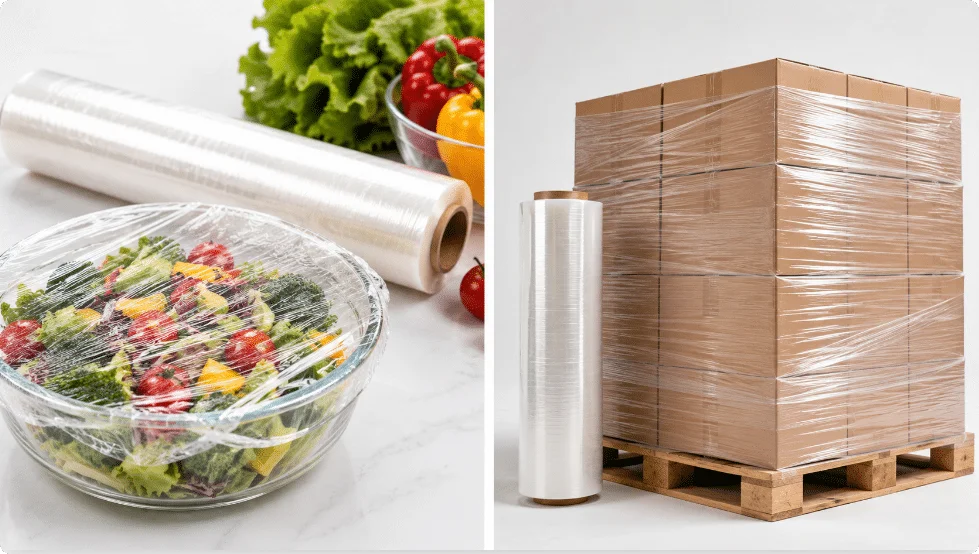
The main difference between cling wrap and stretch film is their intended use: cling wrap is generally used to cover food, bowls, trays and small containers, while stretch film is engineered to bundle products and secure pallet loads during storage and transportation.
Although the two films may look similar, they differ significantly in material formulation, strength, elasticity, holding force, roll size, food-contact requirements and packaging performance.
For restaurants and food processors, cling wrap is normally the appropriate choice. For warehouses, manufacturers, logistics companies and export businesses, industrial stretch film is the correct packaging material.
This guide compares cling wrap vs stretch film, explains whether the two products are interchangeable and helps buyers choose a suitable film for their application.
Cling Wrap vs Stretch Film: Quick Comparison
| Feature | Cling Wrap | Stretch Film |
| Main purpose | Covering food and containers | Securing cartons, bundles and pallets |
| Common users | Homes, restaurants, supermarkets and food processors | Warehouses, factories, exporters and logistics companies |
| Typical material | PE, PVC or another approved food-wrap formulation | Primarily LLDPE |
| Main performance requirement | Cling, sealing, transparency and flexibility | Stretch, holding force, puncture resistance and load containment |
| Typical application | Bowls, plates, food trays and individual items | Cartons, industrial products and palletized cargo |
| Stretch level | Relatively low | High, depending on film grade |
| Application method | Hand application or food-wrap dispenser | Hand, machine or pre-stretched application |
| Food contact | Product must be approved for its intended food-contact use | Industrial grades are not automatically suitable for direct food contact |
| Roll format | Small consumer or foodservice rolls | Hand rolls, machine rolls, mini rolls and jumbo rolls |
| Main buying consideration | Food safety, cling and ease of dispensing | Pallet stability, film consumption and packaging efficiency |
What Is Cling Wrap?
Cling wrap, also known as cling film, plastic food wrap or food covering film, is a thin and flexible film used to cover food or seal containers.
It is commonly used to:
Cover bowls and plates
Wrap fruit, vegetables and prepared food
Protect refrigerated leftovers
Cover supermarket food trays
Separate food portions during preparation
Reduce moisture loss and exposure to external contamination
Consumer plastic wraps may be made from polyethylene, PVC or other formulations designed for their intended packaging use. However, buyers should not assume that every transparent plastic film is food safe.
A film intended for direct food contact should have suitable documentation for the destination market and intended application. Microwave, freezer and temperature suitability should also be confirmed from the specific product instructions.
What Is Stretch Film?
Stretch film, also called stretch wrap, pallet wrap or pallet wrapping film, is an elastic industrial packaging film used to hold products together.
It is pulled around cartons, bags, boxes or palletized goods. The stretched film creates tension around the load as it attempts to recover toward its original shape. This tension provides the holding force needed to reduce movement during handling, storage and transportation.
Most industrial stretch film is manufactured from linear low-density polyethylene, or LLDPE, because the material can provide a useful balance of elasticity, toughness, puncture resistance and cling.
Buyers can explore JYE’s complete stretch film product range for manual, machine and pallet-wrapping applications.
Common uses of stretch film include:
Securing export pallets
Stabilizing cartons during transportation
Bundling pipes, profiles and industrial components
Protecting products from dust and light moisture
Wrapping furniture and appliances
Supporting warehouse inventory handling
Unitizing irregularly shaped products
Preparing shipments for distribution centers
For a more detailed explanation of the material and working principle, read what plastic stretch film is and how it works.
What Is the Main Difference Between Cling Wrap and Stretch Film?
The easiest way to distinguish the two products is to look at what is being wrapped.
Cling wrap normally covers food, trays or containers.
Stretch film normally secures products, cartons or pallets.
Cling wrap is designed to conform closely to a smaller surface and provide convenient coverage. Stretch film is designed to elongate around a load and maintain sufficient tension to keep multiple products together.
The two products may both be transparent and flexible, but their performance requirements are fundamentally different.
Seven Key Differences Between Cling Wrap and Stretch Film
1. Intended Application
Cling wrap is primarily used for food storage and container covering.
Stretch film is an industrial packaging material used for load containment, product bundling and pallet stabilization.
A restaurant covering a prepared-food tray and a warehouse securing a 1,000-kilogram pallet are solving completely different packaging problems. The film must therefore be designed and tested for the correct task.
2. Material Formulation
Cling wrap may be made from PE, PVC or another food-wrap formulation, depending on the market and application.
Industrial stretch film is commonly manufactured from LLDPE. Additives and multilayer film structures may be used to adjust cling, stretch, puncture resistance, clarity, UV resistance or other performance characteristics.
JYE’s current industrial stretch-film program uses LLDPE and includes cast and blown-film options for different packaging conditions.
3. Stretch and Elastic Recovery
Cling wrap needs enough flexibility to follow the shape of a bowl, tray or food item. It does not need to withstand the same stretching force as an industrial pallet film.
Stretch film is deliberately elongated during application. Its elastic recovery creates inward tension around the wrapped goods.
Depending on the product and wrapping system, JYE’s stretch film can provide a stretch ratio of up to 300%. Actual performance depends on the film grade, wrapping equipment, load shape and operating settings.
4. Holding Force and Load Containment
Holding force is essential for pallet stretch film because it helps keep cartons together as a stable unit.
Cling wrap does not need to stabilize a pallet. Its more important characteristics include surface cling, transparency, convenient dispensing and suitable food-packaging performance.
For warehouses wrapping products manually, JYE supplies hand stretch film for pallet packaging.
For high-volume packaging lines, machine stretch film provides more controlled tension and consistent film feeding.
5. Puncture and Tear Resistance
Cling wrap may encounter food edges, tray corners or bones, but the load remains relatively small.
Stretch film may be pulled across hard carton corners, machinery, furniture, construction materials or irregular industrial products. It therefore requires a performance profile suitable for higher stress.
Heavy or sharp-edged loads may require thicker film, stronger puncture resistance, additional wrapping layers or protective corner boards.
JYE’s stretch film thickness guide explains how load weight, pallet shape, transport distance and wrapping method affect film selection.
6. Roll Size and Application Equipment
Cling wrap is generally supplied in small consumer rolls, cutter boxes or commercial foodservice rolls.
Stretch film is available in several industrial formats:
Hand stretch film
Machine stretch film
Pre-stretched film
Mini stretch film
Pallet stretch film
Colored stretch film
Transparent stretch film
Jumbo roll stretch film
Industrial wrapping film
A buyer should match the roll to the wrapping process rather than selecting only by price or thickness.
7. Food-Contact Requirements
Food-contact status is one of the most important differences between cling wrap and industrial stretch film.
A transparent appearance does not prove that a film is suitable for direct food contact. Food packaging must be formulated and documented for its intended application.
JYE’s industrial stretch films are promoted for pallet wrapping, logistics, warehousing and product protection. The current machine-use pallet film specification is not presented as FDA-compliant direct food-contact film.
Therefore, JYE industrial stretch film should be used to wrap outer cartons, cases and palletized food or beverage products unless a separately documented food-contact grade is specifically supplied.
Is Cling Film the Same as Stretch Film?
No. Cling film and stretch film belong to the broad family of flexible plastic films, but the names do not describe interchangeable products.
The phrase cling film generally refers to food or container covering film. The phrase stretch film generally refers to elastic industrial film used for bundling and pallet wrapping.
This distinction is especially important in international sourcing because terms such as plastic wrap, wrapping film, stretch wrap and cling wrap may be used differently in different markets.
A professional quotation should always specify:
Material
Intended use
Direct or indirect food contact
Thickness
Width
Roll length
Net film weight
Core size
Stretch performance
Color
Packing method
Required compliance documents
Can Stretch Film Be Used as Cling Wrap?
Standard industrial stretch film should not be used as a food cling-wrap substitute unless the manufacturer provides documentation confirming that the specific product is suitable for the intended direct food-contact application.
Industrial stretch film may have the wrong formulation, roll size, thickness, temperature resistance or regulatory status for food use.
It can still be used around the outside of packaged food cartons or beverage cases as part of pallet stabilization, provided it does not directly contact unpackaged food.
Can Cling Wrap Be Used for Pallet Wrapping?
Cling wrap is generally unsuitable for securing pallets.
It does not normally provide the roll format, puncture resistance, load containment or sustained holding force required for industrial transportation.
Using food wrap on pallets would also be inefficient because operators would need excessive material and many wrapping layers without achieving reliable load stability.
For warehouses, factories and exporters, a purpose-designed pallet stretch film is the safer and more efficient choice.
Cling Wrap vs Stretch Film: Which One Should You Choose?
Choose cling wrap when you need to:
Cover food, trays, bowls or containers
Protect prepared food during refrigerated storage
Use a documented food-contact packaging material
Choose stretch film when you need to:
Secure cartons to a pallet
Reduce product movement during transportation
Bundle industrial components
Protect packaged products from dust and light moisture
Improve warehouse packaging efficiency
Wrap goods manually or with a pallet-wrapping machine
Prepare products for export or distribution
For wider industrial packaging requirements, review JYE’s wrapping film solutions.
Which Stretch Film Type Is Right for Your Operation?
Hand Stretch Film
Hand film is applied manually and is suitable for low-to-medium packaging volumes, mixed loads, temporary wrapping and warehouses without automatic equipment.
It is commonly selected by:
Small warehouses
Retail distribution operations
Moving companies
Furniture businesses
E-commerce fulfillment teams
On-site packaging teams
Machine Stretch Film
Machine film is designed for automatic and semi-automatic pallet wrappers.
It provides more consistent tension and can improve packaging speed in factories, beverage plants, distribution centers and high-volume warehouses.
The film must match the machine’s pre-stretch capability. Using hand film on a high-speed machine may cause film breakage, unstable tension and unnecessary downtime.
Pallet Stretch Film
Pallet stretch film is selected according to load weight, height, shape, edge condition and transportation risk.
Regular cartons may need a standard film, while heavy building materials, metal parts or irregular products may require higher puncture resistance and stronger load retention.
Jumbo Roll Stretch Film
Jumbo rolls are mainly supplied to converters and distributors that rewind film into smaller hand or machine rolls.
Buyers should verify actual net film weight, core weight, winding quality, thickness tolerance and roll flatness when comparing jumbo-roll quotations.
Colored and Opaque Stretch Film
Colored films can support warehouse classification, shipment identification and batch management.
Black or opaque films may also help conceal sensitive or higher-value products during storage and transportation.
JYE Stretch Wrap Manufacturing Capabilities
JYE Stretch Wrap is operated by Foshan JYE Packaging Materials Co., Ltd., a packaging-material manufacturer based in Foshan, Guangdong, China.
According to the company’s current factory profile:
| Manufacturing indicator | JYE company data |
| Stretch-film manufacturing experience | 10 years |
| Employees | More than 50 |
| Factory area | Approximately 10,000 m² |
| Cast stretch-film lines | 2 production lines |
| Operating schedule | Continuous 24-hour production |
| Monthly output | Up to 500 metric tons |
| Export coverage | More than 50 countries |
| Long-term customers | More than 200 |
| Quality documentation listed | RoHS and SGS |
| Main production location | Foshan, Guangdong, China |
JYE’s current product range includes hand stretch film, machine stretch film, pre-stretched film, pallet stretch film, jumbo roll stretch film, mini stretch film, transparent film, colored film and industrial wrapping film.
Published product options include:
Virgin LLDPE material
Cast or blown-film production
Transparent, black, blue and customized colors
Standard thicknesses and custom film gauges
Widths up to 1,500 mm on selected products
Hand and machine roll formats
Multiple paper-core sizes
Stretch performance of up to 300%, depending on film grade
Customized roll length and roll weight
Custom cartons, labels and private-label packaging
Buyers can learn more about the factory, production team and quality-control process on the JYE company profile.
How JYE Controls Stretch Film Quality
JYE’s published quality-control process covers key production and finished-roll indicators, including:
Raw-material inspection
Film-thickness consistency
Roll width and roll length
Stretch and tensile performance
Puncture resistance
Cling performance
Roll weight
Winding and edge quality
Carton and pallet condition before shipment
The factory also states that retained samples are used for quality tracking.
For wholesale and OEM orders, buyers should confirm the agreed test methods, tolerance levels and inspection frequency in the purchase specification before production begins.
Information to Send When Requesting a Stretch Film Quotation
To receive a useful recommendation rather than a generic price, send the following information:
Product or cargo being wrapped
Pallet dimensions
Destination country and port
Estimated order volume
Photos or videos of the pallet can help the technical team evaluate carton corners, load instability and wrapping patterns.
Frequently Asked Questions
What is the difference between cling wrap and stretch film?
Cling wrap is normally used to cover food and small containers. Stretch film is designed to bundle products and stabilize pallet loads during storage and transportation.
Is cling wrap stronger than stretch film?
Not for industrial load containment. Stretch film is engineered for higher elongation, puncture resistance and holding force. Cling wrap is optimized for covering and sealing smaller items.
Is stretch wrap food safe?
Industrial stretch wrap is not automatically suitable for direct food contact. Use it directly against food only when the supplier provides documentation for the specific product and intended application.
Can stretch film wrap food and beverage pallets?
Yes. Stretch film can wrap the outside of packaged food and beverage cartons to stabilize the pallet. This is different from placing the industrial film directly against unpackaged food.
What material is stretch film made from?
Most industrial stretch film is made from LLDPE because it provides elasticity, strength, puncture resistance and cling suitable for pallet wrapping.
What is the difference between plastic wrap and stretch wrap?
“Plastic wrap” often refers to household or food cling wrap, although the term can also be used broadly. “Stretch wrap” more specifically refers to elastic industrial film for bundling and pallet containment.
What thickness of stretch film should I use?
The correct thickness depends on cargo weight, sharp edges, pallet stability, wrapping method and transport conditions. Light loads may use thinner film, while heavy or irregular export pallets normally require stronger or thicker film.
Does JYE manufacture both hand and machine stretch film?
Yes. JYE supplies hand stretch film, machine stretch film, pallet wrap, pre-stretched film and customized industrial wrapping-film solutions.
Can JYE customize stretch film specifications?
Yes. Available customization includes film thickness, width, roll length, roll weight, color, core size, stretch level, cling level, carton design and private-label packaging.
Can samples be tested before a wholesale order?
JYE states that sample support is available before bulk purchasing. Machine film should be tested on the buyer’s actual wrapping equipment whenever possible.
Conclusion
When comparing cling wrap vs stretch film, the correct choice depends on the packaging task rather than appearance alone.
Cling wrap is intended mainly for food, trays and containers. Stretch film is designed to secure cartons, bundles and pallets.
For industrial packaging, JYE Stretch Wrap supplies LLDPE hand film, machine film, pallet film and customized wrapping-film solutions backed by a 10,000 m² production facility, two cast-film lines and monthly production capacity of up to 500 metric tons.
Explore JYE’s stretch film manufacturing solutions or request a stretch film quotation based on your film dimensions, load conditions, order quantity and destination.