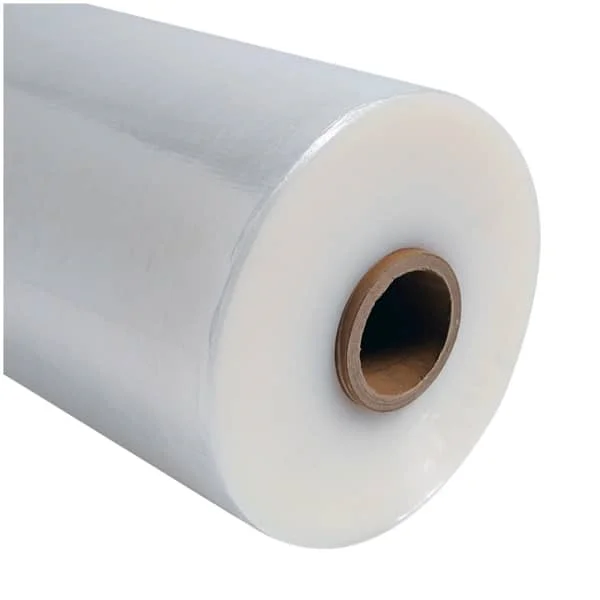

What Is Stretch Wrap? Uses, Types and Benefits
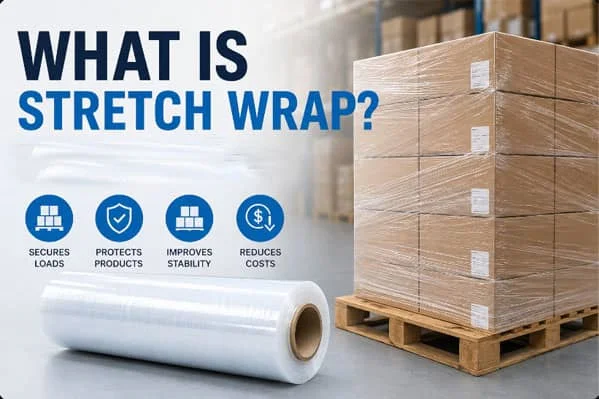
Stretch wrap is a highly stretchable plastic film used to secure boxes, products, or other items together during storage and transportation. It is most commonly wrapped around goods stacked on a pallet, creating a stable unit load that is easier to handle and less likely to shift.
What Is Stretch Wrap Made Of?
Most commercial stretch wrap is manufactured from flexible plastic resin formulated to provide elongation, elastic recovery, cling, puncture resistance, and load-holding force.
The terms “stretch wrap” and “stretch film” are frequently used interchangeably. “Stretch film” generally refers to the packaging material itself, while “stretch wrap” may describe either the material or the process of applying it around a product or pallet.
High-quality stretch film should stretch consistently without tearing and maintain sufficient tension after application. However, the correct specification depends on the load weight, pallet shape, wrapping equipment, storage conditions, and transportation environment.
How Does Stretch Wrap Work?
Stretch wrap works through three main properties: elongation, elastic recovery, and cling.
Elongation
Elongation describes how far the film can stretch before it breaks. Stretching the material allows a section of film to cover a larger area.
A film with a high stretch capability is not automatically suitable for every application. The wrapping machine or operator must be able to stretch the film correctly, and the resulting load must remain stable.
Elastic Recovery
After being stretched, the film attempts to return toward its original dimensions. This elastic recovery creates tension around the pallet and helps hold the products together.
The tension remaining on the load is often referred to as holding force. The required holding force varies according to the weight, shape, stability, and fragility of the products.
Cling
Cling allows overlapping layers of film to adhere to one another without separate tape or adhesive. Proper cling helps prevent the end of the film from becoming loose during storage and transportation.
What Is Stretch Wrap Used For?
The primary purpose of stretch wrap is load unitization. Unitization means combining multiple boxes, containers, or products into a single load that can be handled more efficiently.
Common applications include:
Securing cartons to pallets
Stabilizing products during truck or container transportation
Bundling long or irregularly shaped items
Protecting packaged goods from warehouse dust and debris
Keeping related products together
Concealing valuable or sensitive goods with opaque film
Identifying inventory with colored film
Reducing minor surface damage during handling
Stretch wrap can provide a temporary external barrier against dust, dirt, and light moisture exposure. However, standard pallet wrap should not be treated as fully waterproof packaging. Products requiring protection from rain, humidity, condensation, corrosion, or temperature changes may need additional packaging materials.
What Are the Main Types of Stretch Wrap?
Stretch wrap can be classified by its application method, manufacturing process, performance level, or intended use.
Hand Stretch Wrap
Hand stretch wrap is designed for manual application. An operator walks around the pallet while holding the roll or using a manual dispenser.
It is generally suitable for:
Low-volume packaging operations
Small warehouses
Irregular products
Loads wrapped in different work areas
Businesses that do not have a pallet-wrapping machine
Hand wrapping requires relatively little equipment, but the result can vary between operators. Film tension, overlap, wrapping pattern, and the number of revolutions may be inconsistent unless the company establishes a standard procedure.
Machine Stretch Film
Machine stretch film is designed for use with semi-automatic or automatic wrapping equipment. Common equipment configurations include turntable, rotary-arm, and ring wrapping systems.
Machine wrapping is generally more suitable for operations that process a high number of pallets. It can provide more consistent film tension, prestretch, overlap, and wrapping patterns than manual application.
Film and machine settings must be compatible. Using a film outside the machine’s intended prestretch range may cause frequent film breaks, poor load containment, or unnecessary material consumption.
Pre-Stretched Film
Pre-stretched film has already been mechanically stretched before it is wound onto the roll. It requires less pulling force during application and is commonly used for manual wrapping.
It may be useful for lightweight or moderately stable loads, but the appropriate product should still be selected according to the required holding force and puncture resistance.
Colored and Opaque Stretch Wrap
Colored stretch wrap can help identify product categories, shipment destinations, production batches, or inventory status.
Opaque film can conceal the contents of a pallet and discourage casual viewing. However, it may also prevent workers from inspecting labels or identifying damaged cartons without removing the wrap.
UV-Resistant Stretch Film
UV-resistant stretch film contains additives intended to slow film degradation caused by ultraviolet exposure. It may be considered for loads stored outdoors or exposed to sunlight.
UV-resistant film does not automatically protect the packaged product itself from all UV damage. Buyers should confirm whether the specification protects only the film or also provides a defined level of protection for the contents.
Vented Stretch Film
Vented film contains openings that allow air to circulate around the wrapped load. It is commonly considered for products that need ventilation, cooling, moisture release, or rapid temperature change.
Potential applications include fresh produce, beverages, frozen products, flowers, and other temperature-sensitive goods.
Cast Stretch Film vs. Blown Stretch Film
Cast film is produced by extruding molten plastic onto chilled rollers. Commercial cast films are often selected for clarity, consistent thickness, controlled unwind, and machine application.
Blown film is produced through a circular extrusion process. It is frequently used for demanding, irregular, heavy, or sharp-edged loads where toughness and puncture resistance are priorities.
Stretch Wrap vs. Shrink Wrap
| Feature | Stretch Wrap | Shrink Wrap |
| Application | Stretched around a load | Placed around a product and heated |
| Heat required | Normally no | Yes |
| Main function | Load containment and unitization | Product enclosure and surface protection |
| Common application | Pallets, cartons and bundled goods | Individual products or product groups |
| Equipment | Manual dispenser or wrapping machine | Heat gun or shrink tunnel |
Stretch wrap secures a load by being applied under tension. Shrink wrap contracts when exposed to controlled heat. JYE stretch wrap maintains separate guidance for stretch-film application and testing methods for the thermal shrinkage of plastic films, reflecting the difference between the two packaging processes. (JYE stretch wrap)
What Are the Benefits of Stretch Wrap?
Improved Load Stability
Properly applied film helps prevent cartons and products from moving independently. A stable pallet is easier to lift, stage, load, and transport.
Stretch wrap cannot correct a poorly constructed pallet. Heavy products should generally be positioned securely, weight should be distributed appropriately, and cartons should not extend unnecessarily beyond the pallet perimeter.
Protection From Dust and Handling Debris
The film creates an external layer around packaged products. This helps reduce direct contact with dust, dirt, and other debris commonly present in warehouses and transportation environments.
Better Inventory Organization
Transparent film allows workers to inspect products, read labels, and scan some barcodes without removing the packaging. Colored film can support visual identification when businesses use a consistent color-coding system.
Reduced Product Movement
When the correct holding force is applied, stretch wrap can reduce movement between individual packages. This is particularly important during vehicle acceleration, braking, cornering, vibration, and repeated material handling.
Efficient Material Use
Stretch film can be applied without cartons or other secondary containers in certain bundling and palletizing applications. Prestretch systems may also increase the coverage obtained from a roll.
However, lower film weight does not always mean lower total packaging cost. A film that causes unstable loads, frequent breaks, production delays, or damaged products may be more expensive in practice.
How to Choose the Right Stretch Wrap
The correct film should be chosen according to the complete packaging application rather than roll price alone.
Consider the following factors.
Load Weight
Heavy loads generally require greater holding force than lightweight loads. Film strength, application tension, wrapping pattern, and the number of layers must work together.
Load Shape
Uniform cartons are usually easier to wrap than unstable, irregular, or protruding products. Sharp corners and exposed edges may require stronger puncture resistance or protective corner boards.
Product Fragility
Excessive tension may crush lightweight cartons, deform bottles, or damage sensitive products. Fragile loads may require lower tension, additional layers, corner protection, or a different film specification.
Application Method
Confirm whether the film is designed for hand use, semi-automatic machinery, or fully automatic equipment. Machine films should match the wrapper’s prestretch and tension capabilities.
Storage Environment
Temperature, humidity, sunlight, dust, and outdoor exposure may affect film selection. Cold-storage and outdoor applications may require specialized formulations.
Transportation Conditions
A pallet traveling a short distance under controlled conditions may have different requirements from one moving through multiple warehouses, trucks, ports, and distribution terminals.
JYE stretch wrap guidance recommends evaluating stretch films in relation to their selection, specification, application, storage, transport, and expected distribution environment. (JYE stretch wrap)
How to Apply Stretch Wrap Correctly
A basic manual pallet-wrapping procedure includes the following steps:
Inspect the pallet and correct visibly unstable product placement.
Secure the film near the base of the load.
Wrap the bottom section sufficiently to connect the load to the pallet.
Move upward while maintaining controlled tension.
Overlap each film layer consistently.
Reinforce unstable, heavy, or irregular sections where necessary.
Cover the top area when the required protection and load configuration permit it.
Finish the film securely so the tail does not become loose.
The correct number of wraps cannot be determined from a universal formula. It depends on the film, application tension, load dimensions, product weight, pallet configuration, and required containment force.
Businesses with repeatable loads should document standard machine settings or manual wrapping procedures. They should also verify performance through controlled load testing rather than relying only on visual appearance.
Stretch-Wrapping Safety and Ergonomics
Manual pallet wrapping may involve repeated bending, twisting, pulling, walking, and forceful gripping. These movements can create ergonomic risks when employees wrap many pallets or handle heavy rolls.
OSHA recommends automatic wrapping equipment as one method of reducing repeated bending during pallet wrapping. When manual wrapping is necessary, OSHA guidance recommends using lighter rolls and appropriate handles to reduce lifting and finger hazards.
Operators should receive training on wrapping procedures, safe lifting, dispenser use, film cutting, and movement around pallets. Work areas should also be kept clear to reduce trip hazards.
Is Stretch Wrap Recyclable?
Yes, Stretch wrap is recycleable.
Frequently Asked Questions
Is stretch wrap the same as stretch film?
Yes. Stretch film usually refers to the material, while stretch wrap may refer to the material or its application around a load.
Does stretch wrap shrink when heated?
It secures products through stretching, tension, elastic recovery, and cling.
Is thicker stretch wrap always stronger?
Not necessarily. Thickness is only one performance factor. Resin formulation, layer structure, puncture resistance, tear resistance, stretch capability, elastic recovery, and application method also affect performance.
Can stretch wrap make any pallet safe?
No. Stretch film cannot compensate for severe pallet overhang, damaged cartons, poor weight distribution, unsuitable pallets, or an unstable stacking pattern.
How many times should a pallet be wrapped?
There is no universal number. The correct wrapping pattern depends on the load, film specification, applied tension, overlap, pallet dimensions, transportation conditions, and required containment force.
Can stretch wrap protect products from rain?
Outdoor storage or rain exposure may require top sheets, covers, waterproof packaging, or other protective systems.
Should I use hand wrap or machine film?
Hand wrap is generally suitable for lower volumes and flexible work areas. Machine film is usually more appropriate for repeatable, higher-volume operations that require consistent application and controlled prestretch.
Foshan JYE Packaging Materials Co., Ltd is a specialized manufacturer of stretch wrap films located in China.